Many companies start very simply.
At first, a few Excel spreadsheets, email, messages, basic tools, and some internal organization are enough. Orders are entered manually, tasks are agreed on through messages, statuses are checked by phone or chat, and reports are prepared when needed.
For a while, that works.
The problem appears when the business grows, but the way of working stays the same.
Then situations that sound familiar to many companies start to appear:
- the same data is entered multiple times
- information is scattered across different tools
- order and task statuses are not always clear
- the team loses time checking and messaging
- reports are prepared manually
- Excel spreadsheets become larger and harder to maintain
- decisions are made without a complete overview
At that point, the problem is no longer only organization. The problem is that the tools the company uses no longer follow the real way the company works.
When standard tools are no longer enough
Off-the-shelf software can be excellent for many companies. It often solves common needs and makes it possible to start quickly.
However, every company develops its own processes over time.
The way you receive orders, organize deliveries, track clients, assign tasks, create reports, or manage internal communication can be specific to your team and your industry.
That is when companies often start adapting to the software, instead of the software supporting the company.
Employees create workarounds. They make additional Excel files. They copy data from one system to another. They track statuses in messages. They combine several tools that do not communicate with each other.
In the end, the software exists, but the process still depends on manual work.
What does custom software mean?
Custom software is not just “another program”.
It is a system built around the specific way your company works.
Such a system can include:
- business dashboards
- admin panels for the team
- order management systems
- client records
- task and status tracking
- delivery organization
- internal reports
- automation of manual processes
- integrations with existing tools
- AI solutions for data processing and task automation
The goal is not to change everything at once.
The goal is to first find the part of the process that takes the most time, causes the most mistakes, or slows the team down the most — and simplify that part.
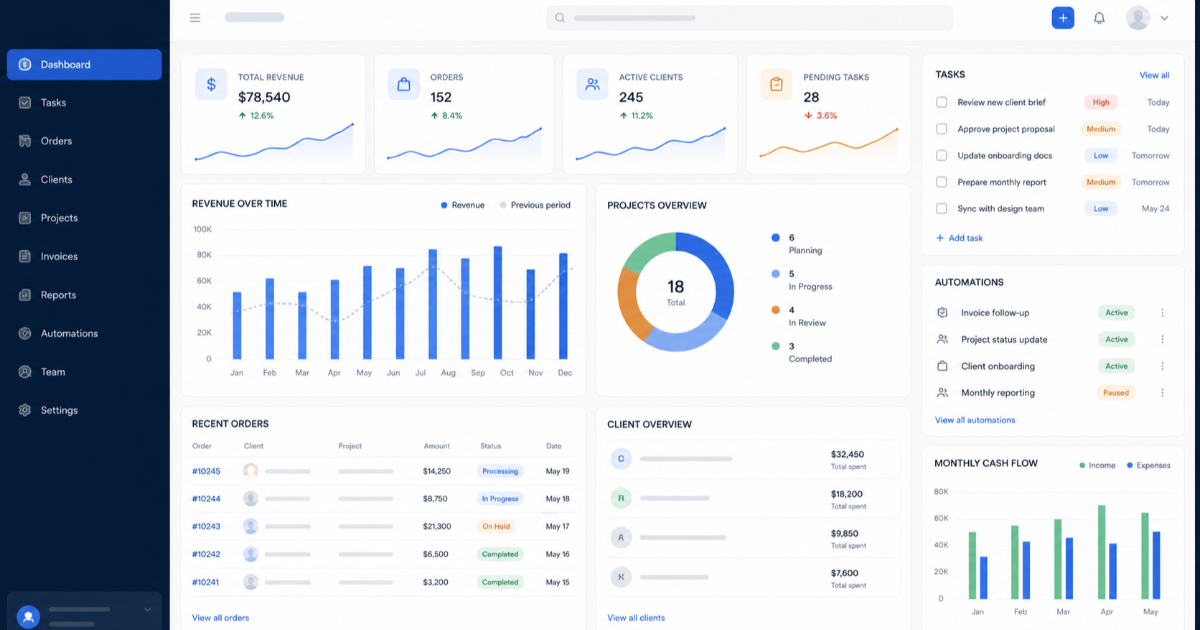
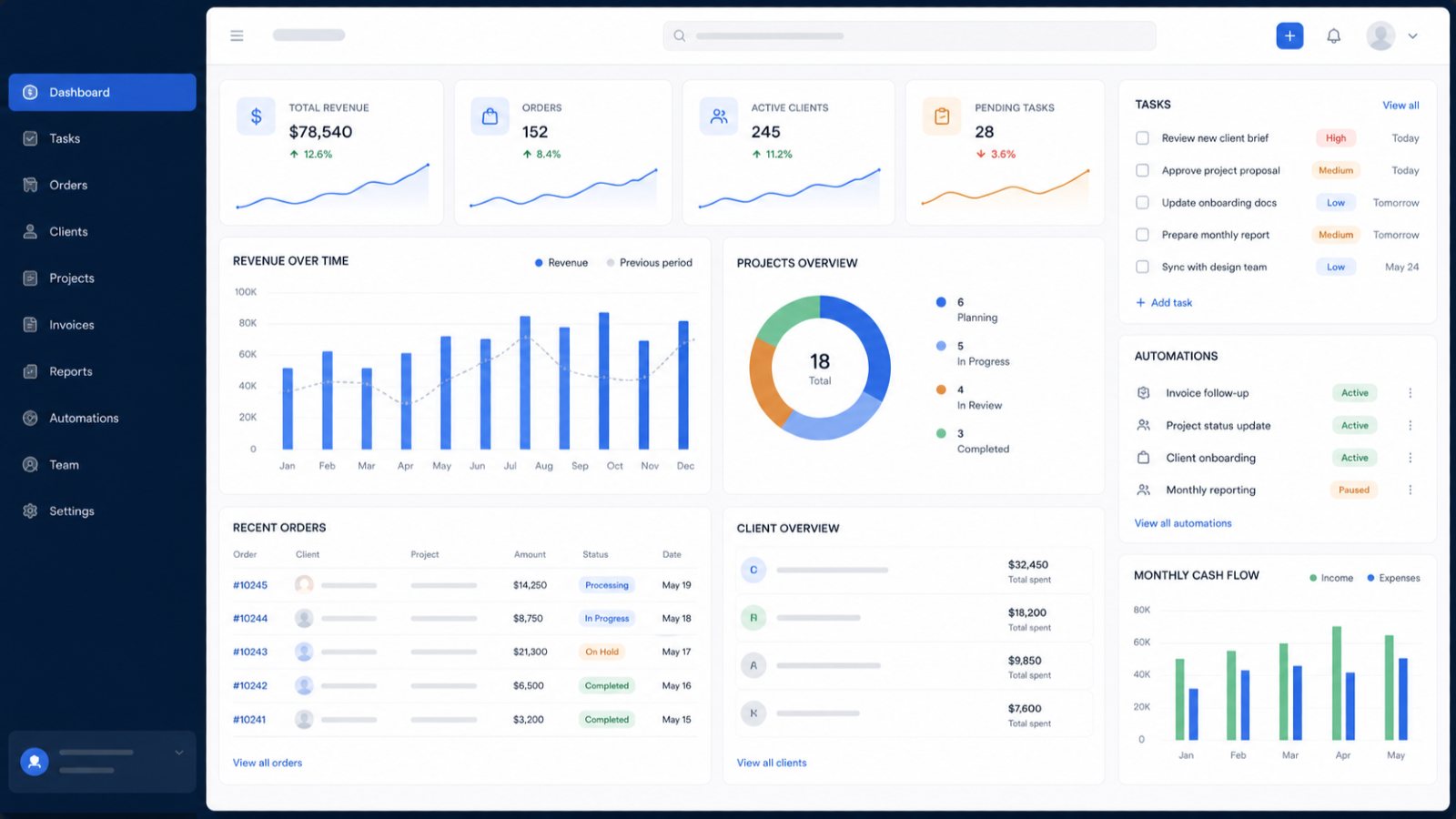
Dashboards: a clearer business overview
One of the most common problems in companies is the lack of a clear overview.
The data exists, but it is scattered. One part is in Excel, another in emails, another in accounting software, another in messages or internal documents.
A dashboard makes important information visible in one place.
For example:
- number of new orders
- open tasks
- late deliveries
- active clients
- revenue by period
- process statuses
- team performance
- unfinished requests
A good dashboard is not valuable because it looks nice. Its value is that it helps the team and management quickly see what is happening and where they need to react.
Admin panels: control over internal processes
An admin panel is an internal tool that allows the team to manage data and processes without unnecessary complexity.
Through an admin panel, a company can:
- add and edit orders
- change statuses
- assign tasks
- track users and clients
- manage employee roles
- review reports
- maintain records
- organize daily work
Unlike generic software, a custom admin panel can be built specifically for the workflow the company already uses.
That means fewer unnecessary options, less confusion, and simpler work for the team.
Automation of manual work
A large part of time in companies is not spent on complex tasks, but on repeating the same simple steps.
For example:
- copying data from email to Excel
- sending the same notifications to clients
- manually checking statuses
- copying data from one program to another
- creating reports from multiple sources
- reminding employees or clients
- organizing tasks through messages
Automation helps reduce or completely remove those steps.
Instead of employees doing the same things manually every day, the system can automatically process data, create a task, send a notification, update a status, or prepare a report.
The result is fewer mistakes, less waiting, and more time for work that actually requires human attention.
Where does AI fit in?
AI is not the solution to every problem, but it can be very useful when there is a clear business task.
The biggest value of AI is not that it is a “modern add-on”, but that it helps where data is hard to process with traditional rules.
For example, AI can help with:
- reading orders from emails
- processing documents
- extracting important information from text
- preparing responses to clients
- searching an internal knowledge base
- classifying requests
- creating tasks based on a message
- analyzing data and reports
- connecting business information through a chat interface
AI makes the most sense when it is connected to the real data, tools, and processes of the company.
Then it is not only used for answering questions. It can become part of a system that helps the team finish work faster.
Integrations with tools you already use
In many cases, a company does not have to replace all the tools it already uses.
Often, it is smarter to connect existing systems.
For example:
- Excel or Google Sheets
- CRM
- accounting software
- invoicing tools
- e-commerce platforms
- order management systems
- communication tools
- internal databases
When those tools are connected, data no longer has to be manually moved from one system to another.
This allows the company to keep what already works, while removing unnecessary manual work between tools.
Software should follow your process
The best business systems are not the ones with the most features.
The best systems are the ones the team actually uses.
That is why software should not be built only from a list of features, but from an understanding of the process.
Before building any solution, it is important to answer questions such as:
- How do you currently work?
- Where is the most time lost?
- Which data is repeated?
- Where do mistakes most often happen?
- What is checked manually?
- Which statuses are unclear?
- Which information is management missing the most?
- Which part of the process slows the team down the most?
Only when the process is understood is it possible to build a system that has real value.
The advantage of a phased approach
Custom software does not have to be a large project from the start.
Often, the best approach is to start in phases.
The first phase can solve only the most important problem, for example:
- a centralized overview of orders
- a simple dashboard
- an admin panel for the team
- a system for statuses and tasks
- automation of one manual process
After that, the system can be expanded.
New features, integrations, reports, or AI automation can be added once it becomes clear where they bring the most value.
This approach reduces risk and allows the company to get a concrete result quickly.
When is it time for an internal business system?
It may be time to consider an internal system if you recognize some of these situations:
- Excel is no longer enough
- the team constantly searches for information
- statuses are checked through messages
- multiple people enter the same data
- mistakes often happen in records
- reports are prepared manually
- clients wait because of internal disorganization
- you have multiple tools that are not connected
- the business depends on someone “knowing by memory” what is happening
These are clear signs that the process can be organized better.
Conclusion
Software should not make business more complicated.
Good software should simplify everyday work, reduce manual entry, connect important information, and provide a better overview of the business.
That is why we believe software should be tailored to your business — not the other way around.
Whether you need a dashboard, admin panel, order management system, automation of manual processes, integration of existing tools, or an AI solution, the most important thing is that the system solves a concrete problem.
Technology makes sense only when it brings clear business value.
If your current tools no longer match the way you work, we can review your processes and propose software, automation, or an AI solution tailored to your company.